
A DEEPER RECESS 014: a conversation with Sumayya Vally
We speak to South African architect, curator & collaborator about the new Ibraaz cultural centre, the Islamic Arts Biennal, her Serpentine Pavilion & more.

07 October 2025
Welcome to the 14th edition of A Deeper Recess, our ongoing series of long-form conversations with leading figures across art and architecture. This time we bring you a conversation between recessed.space editor Will Jennings and South African architect, curator, and collaborator Sumayya Vally.
Vally is the Architect-in-Residence at Ibraaz, a new cultural and community space for the Global Majority in the heart of London. Ibraaz opens to the public on 15 October 2025, further details to be announced at: www.ibraaz.org
An interview with Sumayya Vally
Sumayya Vally is an architect with a genuinely interdisciplinary and collaborative practice – as likely to be found curating an arts biennial, developing a community project as she is laying out plans for a grand new architectural project. In 2023, Vally was the inaugural curator of the Islamic Arts Biennial in Jeddah, work that involved not only selecting work and designing the spatial approach for the event, but also collaborating with the wider team on the institutional framework and thinking how to create a new kind of biennial.
Another ongoing high-profile project is the Asiat-Darse pedestrian bridge in Vilvoorde, Belgium. Her response to the brief was not one only to solve programmatic and structural needs, but to introduce historical narrative, community collaboration, and de-colonisation practices as part of a green crossing that also acts as memorial to the life of Paul Panda Farnana, one of the most important, yet least acknowledged figures of the city and the nation’s colonial legacy in the Congo.
In 2021 Vally was named as one of 100 Leaders of the Future by Time magazine then later that year opened Counterspace’s Serpentine Pavilion. It was a project embedded with many of the architects’ principles, built around ideas connected to past and existent places of meeting from many of London’s communities. These include the Mangrove restaurant from where Notting Hill Carnival emerged, Dalston’s Four Aces Club, the city’s earliest mosques, the Rio Cinema, Brixton Market, the Feminist Library, the Tabernacle, and Centerprise publishing space – amongst many more all listed on the Counterspace website HERE.
For the first time, the Serpentine Pavilion did not only exist on its usual Hyde Park lawn, but instead included fragments at community spaces across the city as temporal, adaptable, and playful architectural moments that sat alongside collaborations by Vally with various makers and community members on a diverse array of projects including a radio station in Becontree, a sound system at the Tabernacle, and with one of the UK’s first Black publishers, New Beacon Books.
Further recognition followed that of Time and the Serpentine Gallery, including a 2022 Young Global Leader by the World Economic Forum, an honorary Fellowship of the Architectural Institution of Canada, an FT Woman of the Year 2023, is an honorary Professor at UCL Bartlett, and is on the Board of Directors of the World Monument Fund.
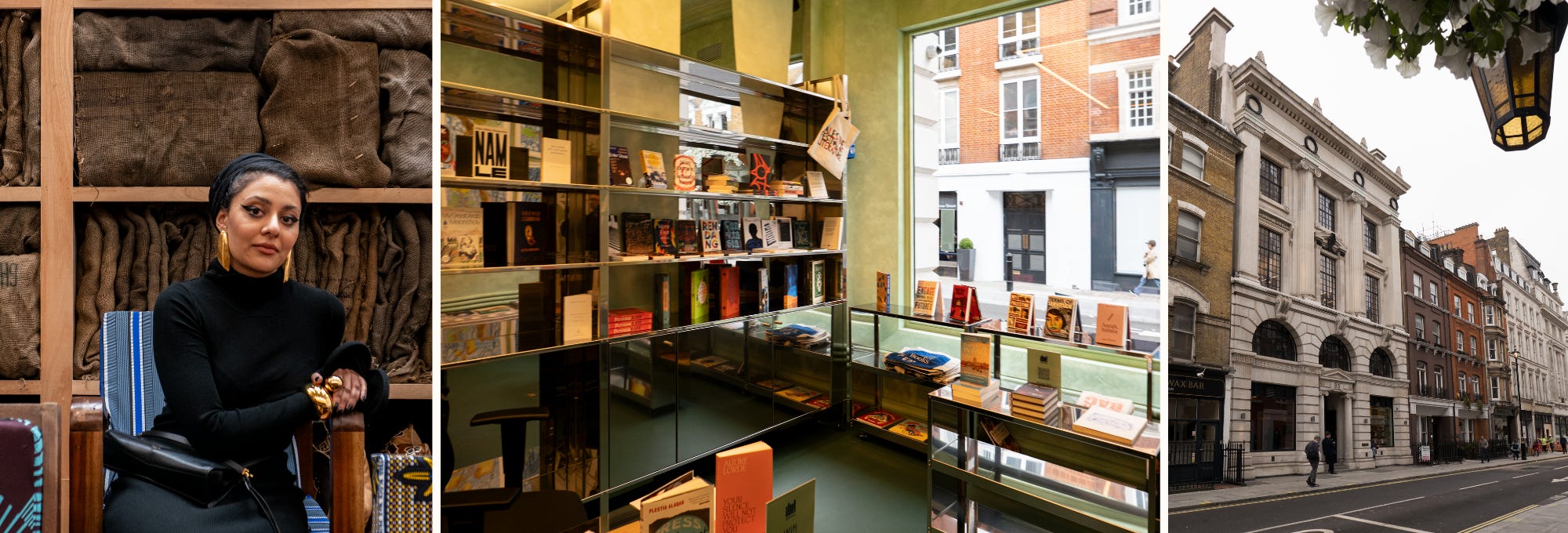
In a practice statement, Counterspace state that their work is “dedicated to articulating expressions of hybrid identities and spaces, with a focus on African and Islamic conditions that are both indigenous and diasporic.” This intent is especially present in Vally’s latest project, Ibraaz, a new London cultural space dedicated to advancing critical thought and artistic practice for the Global Majority. It works with and delicately reconfigures a grand neo-classical property on Mortimer Street, just off Portland Place, and while the building is imminently to be opened to the public, Vally’s work on it is not complete.
She will remain connected to Ibraaz as an Architect-in-Residence, further opening up and exploring ways to reconfigure the existing place, but in a collaborative and observant way. This is not a project where the architect conjures a singular design then hands over a jewel of a building, but instead is an iterative project that will evolve to the emergent needs of its audience, users, and developing institutional demands. Thus, Vally is not just an architect of a building, but also the new institutional framework and potentiality of the place, and will stay with Ibraaz following its launch to continue its development.
Ibraaz opens with Ibrahim Mahama’s sculptural, spatial work Parliament of Ghosts, providing a rich aesthetic interjection into the grand ground-floor hall, and also setting out a marker of intent for the space and its future uses. The installation sits in the space perfectly, and marries the disciplines of art and architecture in a subtle, careful way – the subject we began the conversation on: